Circuits
The Circuit class is designed to make building circuits easier, in particular
by handling as much wiring as possible (including the pesky attaching and detaching).
Note
If you haven’t read the guide on wiring, I recommend you read
that first — the Wire is what Circuit uses under the bonnet
to do component connection, and won’t repeat the coverage of how those connections
are plotted.
Adding and removing components
Adding and removing components is very simple, and mirrors the API for Manim
manim.scene.scene.Scenes: add() is used to add
one or more components, and remove() removes one or more components.
Adding wires
Wires are added using the connect() method. This mirrors the signature
of the Wire constructor; the first parameter is the terminal to go from, the
second is the terminal to go to. One caveat here is that all terminals passed to
connect() must belong to components in the circuit, i.e. they must have
been added first.
Tip
If you want to connect a component in a given circuit to one not in that circuit,
you can use either a Wire or a ManualWire, which work
regardless of what any given components’ parents are — see
here for more info.
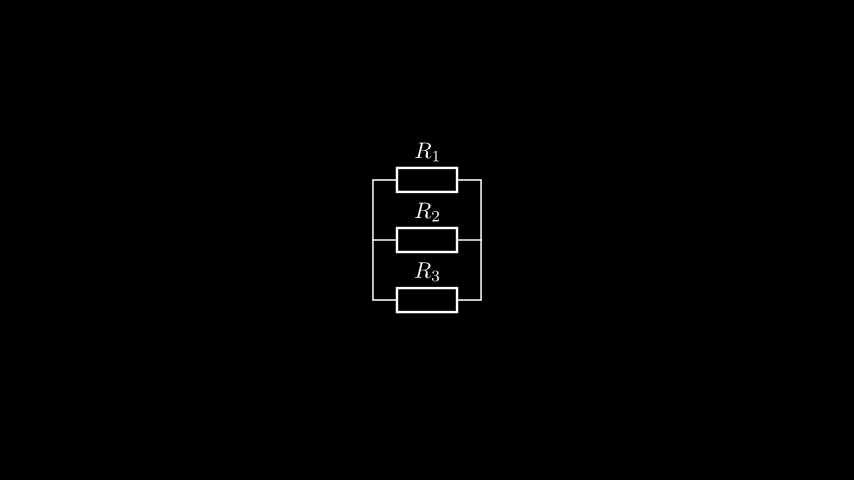
class CircuitExample(Scene):
    def construct(self):
        r1 = Resistor(label="R_1").shift(UP)
        r2 = Resistor(label="R_2")
        r3 = Resistor(label="R_3").shift(DOWN)
        c = Circuit(r1, r2, r3)

        c.connect(r1.right, r2.right)
        c.connect(r2.right, r3.right)
        c.connect(r1.left, r2.left)
        c.connect(r2.left, r3.left)

        self.add(c)
Note
You’d normally add some Nodes to have solder blobs either side of R2,
but I’ve omitted these here to keep the example short.
Removing wires
There are two ways of removing wires from a circuit: disconnect() and
isolate(). These vary slightly in how they decide if a wire is to be
removed, but otherwise work identically. They take an arbitrarily long list of end
specifiers, which can be either Components or Terminals
(passing a component is shorthand for passing all of its terminals).
Disconnection
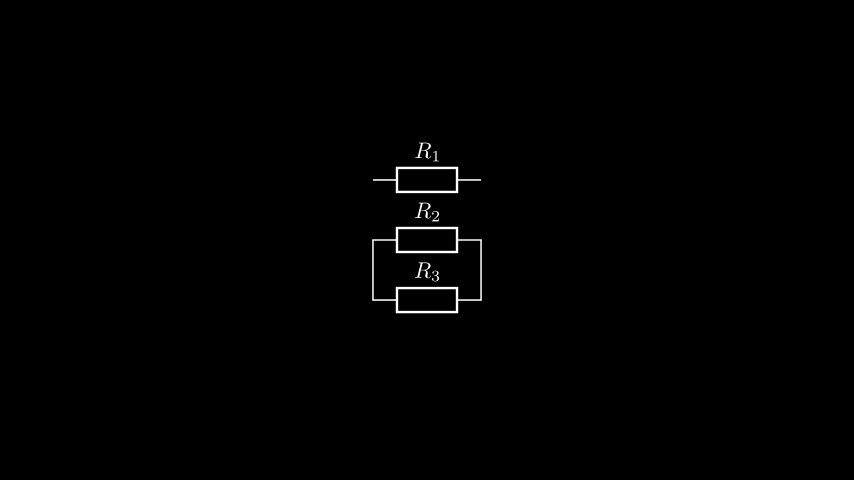
The disconnect() method will only remove a wire if both the start and
end of the wire are passed as arguments. In the example below, we disconnect R1 and
R2, with the result we expect.
class CircuitExample(Scene):
    def construct(self):
        r1 = Resistor(label="R_1").shift(UP)
        r2 = Resistor(label="R_2")
        r3 = Resistor(label="R_3").shift(DOWN)
        c = Circuit(r1, r2, r3)

        c.connect(r1.right, r2.right)
        c.connect(r2.right, r3.right)
        c.connect(r1.left, r2.left)
        c.connect(r2.left, r3.left)

        c.disconnect(r1, r2)

        self.add(c)
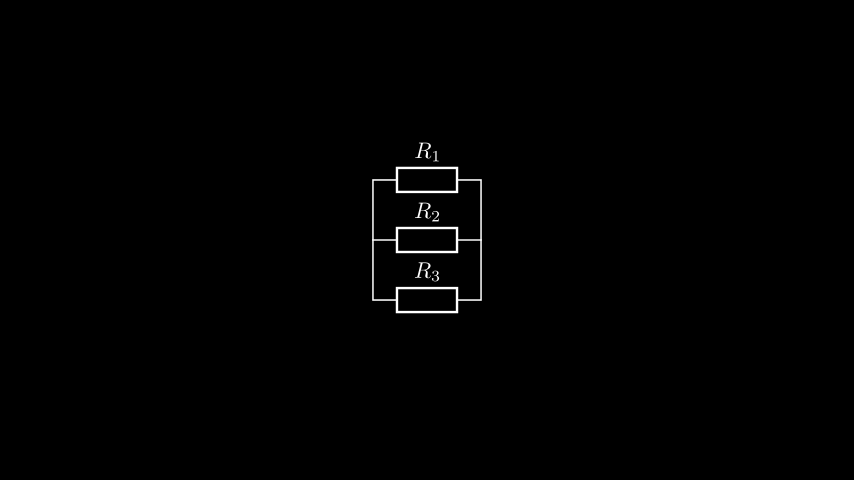
To drive the point about needing to pass both ends home, if we just one end specifier
(say r1.left), nothing will happen.
class CircuitExample(Scene):
    def construct(self):
        r1 = Resistor(label="R_1").shift(UP)
        r2 = Resistor(label="R_2")
        r3 = Resistor(label="R_3").shift(DOWN)
        c = Circuit(r1, r2, r3)

        c.connect(r1.right, r2.right)
        c.connect(r2.right, r3.right)
        c.connect(r1.left, r2.left)
        c.connect(r2.left, r3.left)

        c.disconnect(r1.left)

        self.add(c)
Isolate
You may have been able to guess from our treatment of disconnect() how
isolate() differs. Isolation will remove all wires connected to the
passed end points. If we use the example above, but isolate r1.left rather than
disconnecting it, we see that the wire between R1 and R2’s left terminals is
removed.
class CircuitExample(Scene):
    def construct(self):
        r1 = Resistor(label="R_1").shift(UP)
        r2 = Resistor(label="R_2")
        r3 = Resistor(label="R_3").shift(DOWN)
        c = Circuit(r1, r2, r3)

        c.connect(r1.right, r2.right)
        c.connect(r2.right, r3.right)
        c.connect(r1.left, r2.left)
        c.connect(r2.left, r3.left)

        c.isolate(r1.left)

        self.add(c)
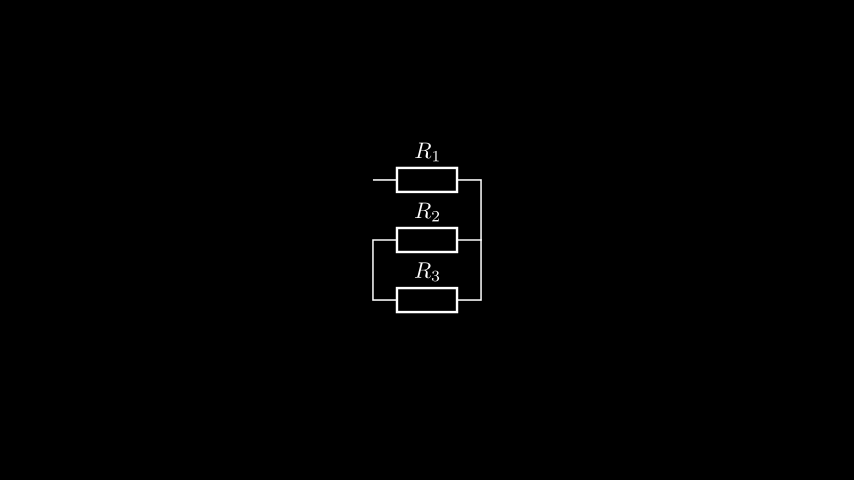
We could also have passed just r1 to remove all wires going to R1, or even r2
to remove all wires full stop (as all wires are connected at one end to one of R2’s
terminals.
Animations
Like everything else in manim-eng, Circuit provides hand-crafted animation
overrides for its methods. An example showcasing this and combining the various
capabilities outlined on this page is below.
class CircuitExample(Scene):
    def construct(self):
        r1 = Resistor(label="R_1").shift(UP)
        r2 = Resistor(label="R_2")
        r3 = Resistor(label="R_3").shift(DOWN)
        c = Circuit(r1, r2, r3)
        self.add(c)

        self.play(
            c.animate.connect(r1.right, r2.right),
            c.animate.connect(r1.left, r2.left),
        )
        self.play(
            c.animate.connect(r2.right, r3.right),
            c.animate.connect(r2.left, r3.left),
        )
        self.wait()
        self.play(
            c.animate.disconnect(r1, r2.left)
        )
        self.wait()
        self.play(
            c.animate.isolate(r3)
        )
        self.wait()